Fantastic review for Hamlet in Diocletian dungeon- Split Summer Festival
Hamlet — A Dance-Psychoanalytic Interpretation and an Experience to Remember
By Magdalena Mrčela
Photo: Mia Milković | 19 July 2026
A dance-psychoanalytic Hamlet, terrifyingly lucid and enchantingly beautiful, brings together the canonical written word and the magic of ballet in a performance that will be remembered.
This is a ballet that speaks, questions, dissects, and psychoanalyses, featuring seven archetypal characters in Renaissance attire, poised between courtly dance and the private “mousetrap” of their own crimes. Svebor Sečak’s chamber ballet Hamlet is a remake of the production first performed in 2004 at the Croatian National Theatre in Zagreb by the Croatia Ballet Company, which subsequently gave more than forty guest performances. At the Split Summer Festival, it was passionately interpreted by a new generation of outstanding ballet dancers: Pavel Savin as Hamlet, Leda Šeparović as Ophelia, Natalia Kosovac as Gertrude, Taiguara Goulart Alves as Claudius, Tom Boddington as Laertes, Dan Rus as Polonius, and Samuele Berbenni as the Ghost of Hamlet’s father.
The opening and closing scenes of Hamlet, within their spiritual space, approach the introspective Baroque and its contemplation of the inevitability of human mortality. The spectral images of candles, resembling the transient flames of the soul, flicker around Hamlet but also devour him, consuming him entirely as one of their own. They expose him as the tragic force behind the disintegration of Elsinore Castle—a site of political corruption and profound spiritual decadence.
In his solo passages, Pavel Savin portrays Hamlet as a lost and wounded boy. The act of kissing his mother’s hand demonstrates that neither his love nor his respect for her has disappeared. Yet his subsequent awareness of her indecently brief mourning for her late husband—Hamlet’s father, evoked in the words “Frailty, thy name is woman”—creates a profound fracture within him that will spill over into all his future relationships with women. Grief and honour, rage and pride, integrity and the moral dilemma of vengeance all collide within him.
Supported by Dinka Jeričević’s meticulously conceived set design and Mladen Šolić’s cinematic lighting, we observe, beneath the palace arches as though through a display window, reminiscences and crimes of the past: the brutal murder of King Hamlet by his ambitious brother, and the tragic wandering of the dead king’s soul, portrayed by Samuele Berbenni with an appropriately spectral presence and an outstanding mask. The awareness that there is a flash in which everything that came before has been preserved—this terrifying sieve of memory, this display case of crime—is crucial to bridging the past and the present.
Before these sombre reflections of the victims, there was splendour: royal festivities in magnificent costumes—the beautiful work of Barbara Bourek—and the intensely intimate and sensual dance between Hamlet’s mother, Queen Gertrude, portrayed by the exceptional Natalia Kosovac, and the new king, Hamlet’s uncle Claudius. Taiguara Goulart Alves embodies Claudius with an excellent balance of seductive charm and tyrannical callousness.
One of the most harrowing moments—and merely one among many demonstrating how thoroughly Svebor Sečak, following Slavko Pervan’s original concept, examined the literary source—is the depiction of the disintegration of Hamlet and Ophelia’s tender love.
Before the audience’s eyes, Leda Šeparović’s ethereal and perfectly stylised form collapses into a discarded and unusable shell, deprived of love, when Savin’s Hamlet forcibly makes the sign of the cross over her. This alludes to the famous words: “Get thee to a nunnery—why wouldst thou be a breeder of sinners?” By doing so, Hamlet also signs Ophelia’s death sentence, represented through another powerful choreographic and lighting device: her motionless body enclosed within blue glass, symbolising the river.
At the same time, he drives the final nail into the coffin of her family. Laertes must bury both his father, Polonius—portrayed by Dan Rus—whom Hamlet mistakenly kills while he is eavesdropping behind a curtain, and his unfortunate sister, whom Hamlet loved and destroyed while feigning madness.
Shakespeare’s “Mousetrap,” the play within Hamlet, does not develop into complex metatheatre in this ballet. Instead, it is compressed within the narrow confines of the palace walls, generating a claustrophobic fear of the inevitable conflict while sharply intensifying the focus on the characters’ inner states.
The confrontation between Hamlet and Laertes is deeply moving. Ultimately, both fall victim to Claudius’s scheming and the poisoned blade of the sword—but not before apologising to one another for the suffering they have caused.
Natalia Kosovac is remarkably convincing as the dying Gertrude, who accidentally drinks the poison intended for Hamlet. In the face and movement of Taiguara Goulart Alves, meanwhile, we see the undisguised rage of a villain who has placed the golden crown taken from a dead man’s head upon his own, only to lose the one person for whom he truly cared.
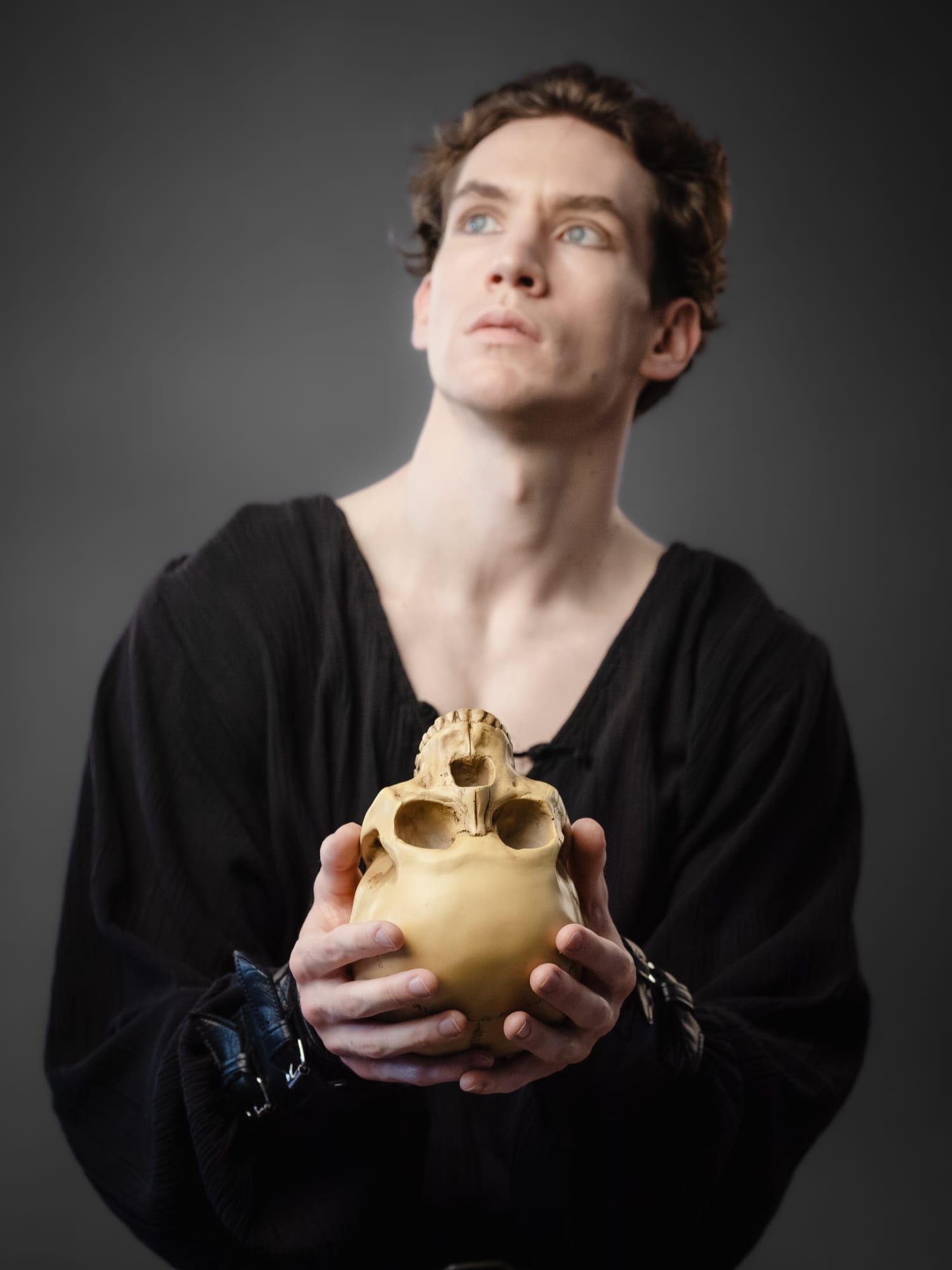
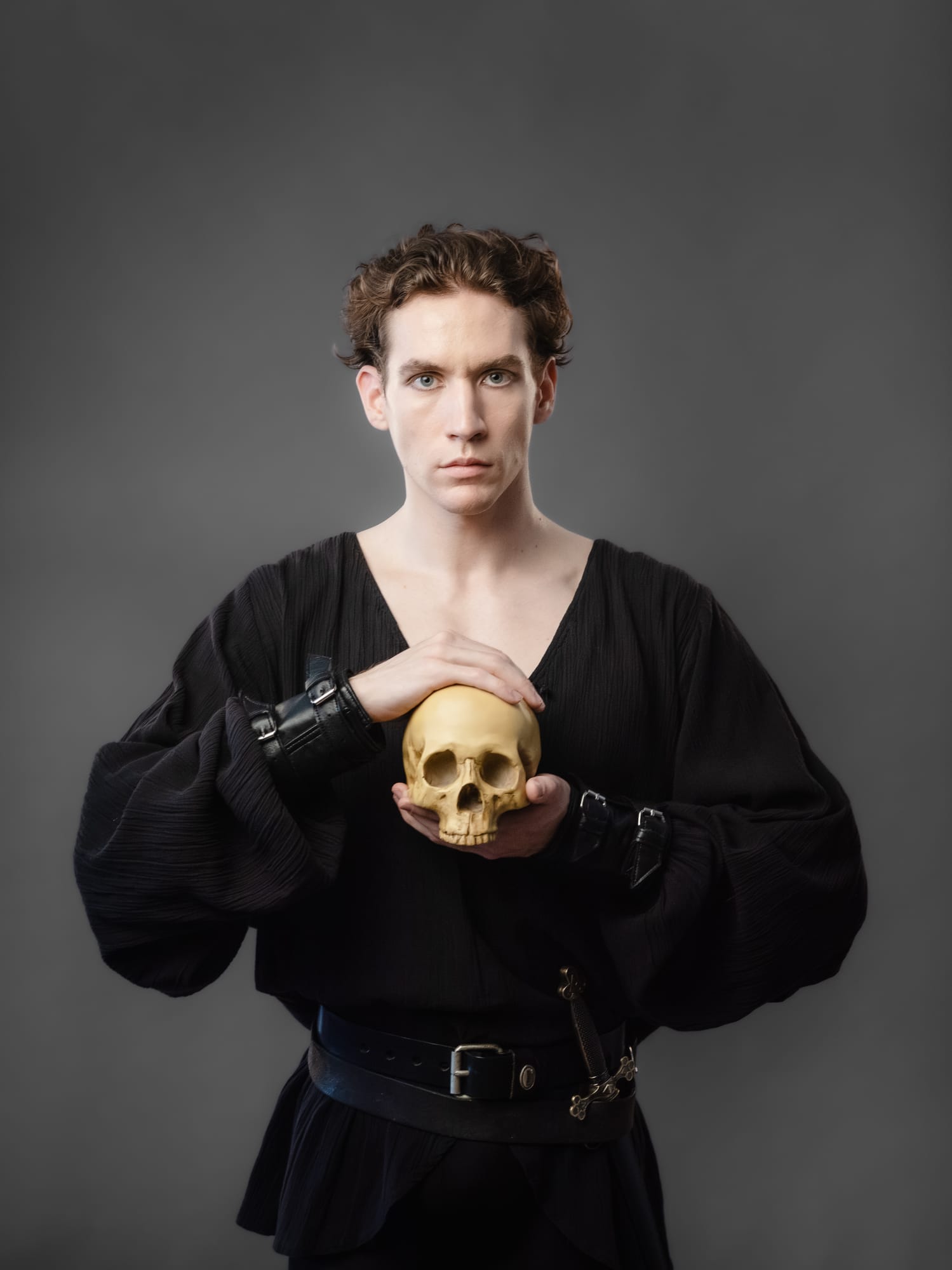
Pavel Savin displays exceptional dramatic expressiveness. He is equally persuasive in his interactions with the other dancers and with the skull—a theatrical prop symbolising human decay. He also commands a broad emotional range in the production’s only “verbal” passage: the verses of the celebrated philosophical soliloquy “To be, or not to be.”
His flawless agility in the pirouettes merges with Hamlet’s sense of being lost amid the perilous turns of his own schemes. The striking final manège not only demonstrates the dancer’s masterful command of space and technique but also becomes a kind of coda to the tragic conflict in which no one emerges victorious. In his quest for vengeance, Hamlet has merely completed a circle of ruin—from his father’s death to his own.
The hour-long spectacle presents Shakespeare’s work with genuine understanding and careful reflection, making the fullest possible use of the libretto by Darko Lukić, based on Shakespeare. It displays dramaturgical intelligence, a perceptive responsiveness to Tchaikovsky’s music, and a performance of captivating beauty and sensitivity, while examining the disintegration of identity before the existential abyss.
The production’s chamber form brings Hamlet closer to the audience and fosters their emotional involvement without diminishing the artistic impact in the slightest.
Compressing such a grand story within the walls of Diocletian’s Palace—as iconic as the walls of Elsinore—also means placing the ballet in a contemporary environment where, only a few metres away, the summer in Split abounds in light entertainment and the instant pleasures of the modern age.
Yet a ballet such as this, through the sheer power of its interpretation, silences all external and internal noise. It places painful introspections directly into the spectator’s hands, holds them transfixed by a sombre yet truthful vision of transience, and confronts them with a work that is timeless.
This dance-psychoanalytic Hamlet, terrifyingly lucid and enchantingly beautiful, unites the canonical written word with the magic of ballet in a performance that will be remembered.