
Excellent review of premiere of ballet Hamlet at the CNT in Varaždin
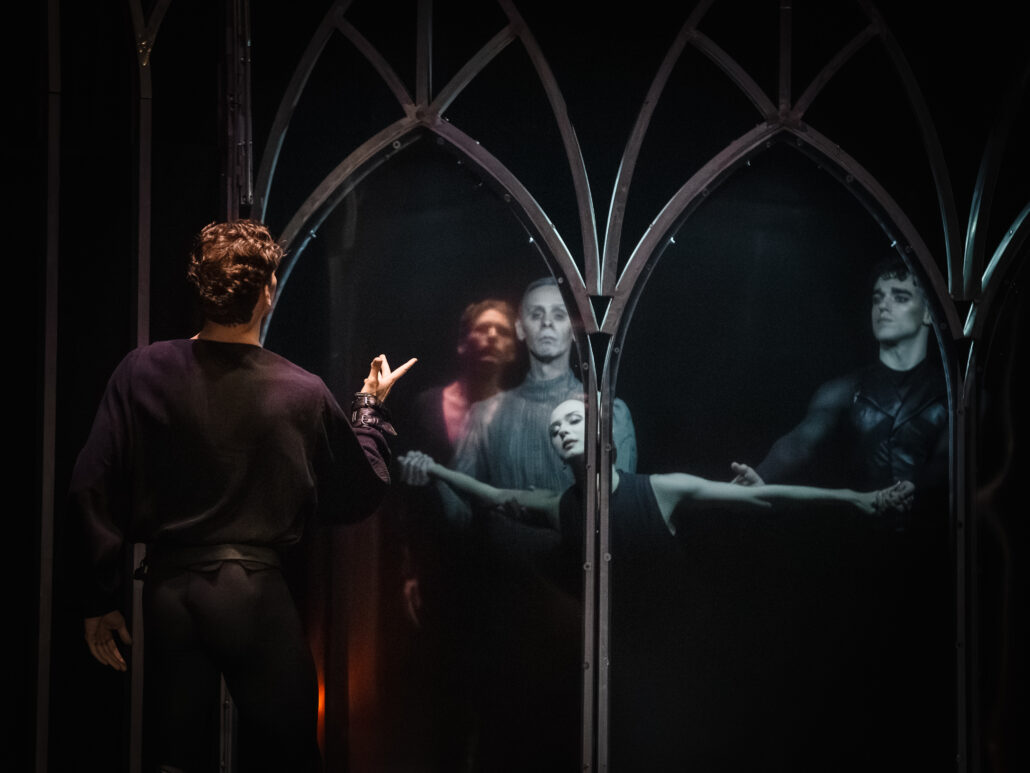
https://www.hia.com.hr/kultura/kazaliste-i-film/item/50095-hamlet-svebora-secaka-kao-baletni-sonet-trijumf-koreografije-ansambla-i-lirske-interpretacije
Svebor Sečak’s Hamlet as a “Ballet Sonnet” — A Triumph of Choreography, Ensemble Performance, and Lyrical Interpretation
By Marija Barić
14 June 2026
To mark the conclusion of its theatre season, the Croatian National Theatre in Varaždin presented its audience with another exceptional premiere. This time, it was Svebor Sečak’s chamber ballet Hamlet, a revival of the production originally premiered in 2004 at the Croatian National Theatre in Zagreb for the Croatia Ballet Company. In the original production, the choreographer himself performed the title role, for which he received the Croatian Theatre Award in 2005.
Over the years, the production achieved notable international success, appearing on numerous stages worldwide—from Sadler’s Wells in London and the National Arts Festival in South Africa to Egypt, Tunisia, Bermuda, and Venezuela—with more than forty guest performances in total. Today, in a co-production between the Croatian National Theatre in Varaždin and the Croatian Society of Professional Ballet Artists, Sečak’s Hamlet comes across not merely as a reconstruction of a former success, but as a carefully considered return to a work that has retained its artistic freshness and relevance for more than two decades.
Looking back on his own choreographic legacy from the perspective afforded by the passage of time, the choreographer has created a production that respects the original while simultaneously opening up space for new interpretations and a new generation of dancers.
Sečak’s approach to Shakespeare’s source material is therefore distinguished by narrative clarity and a deliberate rejection of virtuosic excesses that might overshadow the dramatic core. Instead, movement becomes the language of thought. Hamlet’s existential dilemma, Ophelia’s fragility, Claudius’s guilt, and Gertrude’s inner conflict are articulated through a disciplined ballet vocabulary rooted in the classical tradition while remaining open to modern psychological and philosophical interpretations.
The production’s particular value lies in its many layers. Beneath the seemingly straightforward plot unfolds a network of references—from Shakespeare and Romantic ballet to existentialism and contemporary theories of identity. These references, however, are not intended as a display of erudition; they are woven into the fabric of the production and serve to deepen its central theme: the individual trapped between knowledge and action. Elsinore becomes a symbol of an enclosed world in which all the characters are simultaneously the hunters and the prey of their own destinies.
Pyotr Ilyich Tchaikovsky’s music provides the production with its emotional framework, while Dinka Jeričević’s set design, Barbara Bourek’s costumes, and Mladen Šolić’s evocative lighting create a space situated between reality and the protagonists’ inner worlds. The production’s visual component harmoniously supports the choreographic concept and never distracts attention from the dance, which remains its true centre.
It is precisely the ensemble that represents the greatest strength of this revival.
All the performers demonstrate a high level of technical accomplishment and artistic maturity, creating convincing characters within a demanding choreographic structure. As Ophelia, Leda Šeparović achieves an impressive balance between lyricism and tragedy. Natalia Kosovac brings dignified complexity to the role of Gertrude, while Taiguara Goulart constructs Claudius as a figure of power burdened by concealed anxiety.
Thomas Boddington as Laertes and Dan Rus as Polonius delineate their characters with precision, while Samuele Berbenni, in the role of the Ghost of Hamlet’s father, leaves a powerful impression through his stage presence and evocative expressiveness.
Nevertheless, the centre of the production belongs to Pavel Savin. His Hamlet is not only danced with impeccable technique but also experienced with profound emotional intensity. Savin succeeds in combining the classical elegance of ballet expression with the character’s intense inner drama, conveying Hamlet’s uncertainty, pain, anger, and melancholy through every movement. Particularly striking is his ability to transform complex psychological processes into a clear and communicative stage language, without exaggeration or pathos.
His interpretation carries the production from its opening to its final scene, confirming that a great ballet role is created not through technique alone, but also through artistic intelligence and emotional truth.
Describing this production as a “ballet sonnet” proves to be remarkably apt. Like a sonnet, this Hamlet strives for concision, inner discipline, and clarity of form. Rather than attempting to convey Shakespeare’s entire drama, it extracts its emotional and philosophical core. The result is a work that speaks not through words but through movement, music, and imagery, leaving the audience room for their own reflection on transience, responsibility, and the inevitability of fate.
The memento mori that closes the production does not function as a final moral lesson, but as a quiet echo that continues to resonate long after the curtain has fallen.
This Varaždin revival confirms the enduring value of Sečak’s Hamlet and demonstrates that genuine works of art do not belong solely to the period in which they were created, but to every new generation of performers and spectators who discover within them their own questions and answers.
